Select a case study:
Context & Challenge
Grupo BILD (including BILD and Vitta) is a large Brazilian real estate and construction group with complex commercial operations and a strong focus on scale and efficiency. As part of the group's innovation area, I was appointed as Product Manager responsible for leading the development of a new digital product ecosystem for the commercial function.
The initiative had two strategic objectives:
- Replace a critical legacy commercial system — built exclusively for the group, based on outdated code, and increasingly limited in scalability and flexibility.
- Design the new solution as a SaaS (Software as a Service) product, enabling the group to open a new business vertical by commercializing the platform to other construction and real estate companies.
This required balancing internal operational needs with external market viability from day one.
Problem
The existing commercial system presented multiple structural challenges:
- Outdated and rigid codebase, difficult to evolve or integrate
- High dependency on internal customizations
- Limited ability to scale or adapt to different business models
- No feasibility for commercialization beyond the group
At the same time, simply rebuilding a like-for-like replacement would fail to capture a larger strategic opportunity: transforming an internal tool into a scalable, configurable, and market-ready SaaS ecosystem.
The core challenge was to:
- Deeply understand the legacy system's real value and constraints
- Redefine the commercial platform from a product perspective, not just a system replacement
- Ensure flexibility and modularity to support multiple companies, processes, and sales models
Approach & Role
As Product Manager, I led the initiative end to end, acting as the bridge between business, technology, and strategy.
My responsibilities included:
- Conducting a deep analysis of the legacy commercial system to identify critical workflows, limitations, and retained strengths
- Redefining the product vision and scope for a modular digital ecosystem, rather than a single monolithic system
- Translating business needs into a scalable product architecture suitable for a multi-tenant SaaS model
- Structuring requirements to ensure configurability, adaptability, and future commercialization
- Coordinating closely with engineering, innovation, and business stakeholders throughout discovery and development
The work required constant trade-offs between internal efficiency, long-term scalability, and external market applicability.
Output & Results
- Definition and leadership of a new digital product ecosystem to replace the group's legacy commercial system
- Establishment of a SaaS-oriented product strategy, enabling the platform to be positioned beyond internal use
- Delivery of a flexible, modular scope capable of supporting different commercial structures and companies
- Creation of the foundation for a new software business vertical within Grupo BILD
- Alignment between innovation, technology, and commercial leadership around a shared product vision
Context & Challenge
In mid-2019 and throughout the COVID-19 pandemic, Brazil faced severe challenges in monitoring healthcare system capacity, particularly hospital bed availability. At the state level, the São Paulo government implemented the Plano São Paulo, a regulatory framework that classified regions based on critical indicators — one of the most important being hospital and ICU bed occupancy rates. These classifications directly influenced mobility restrictions and economic activity.
Given my background and interest in innovation applied to public sector management, I was invited to join a Grupo BILD initiative as Product Manager for a public-interest project developed on a pro bono basis.
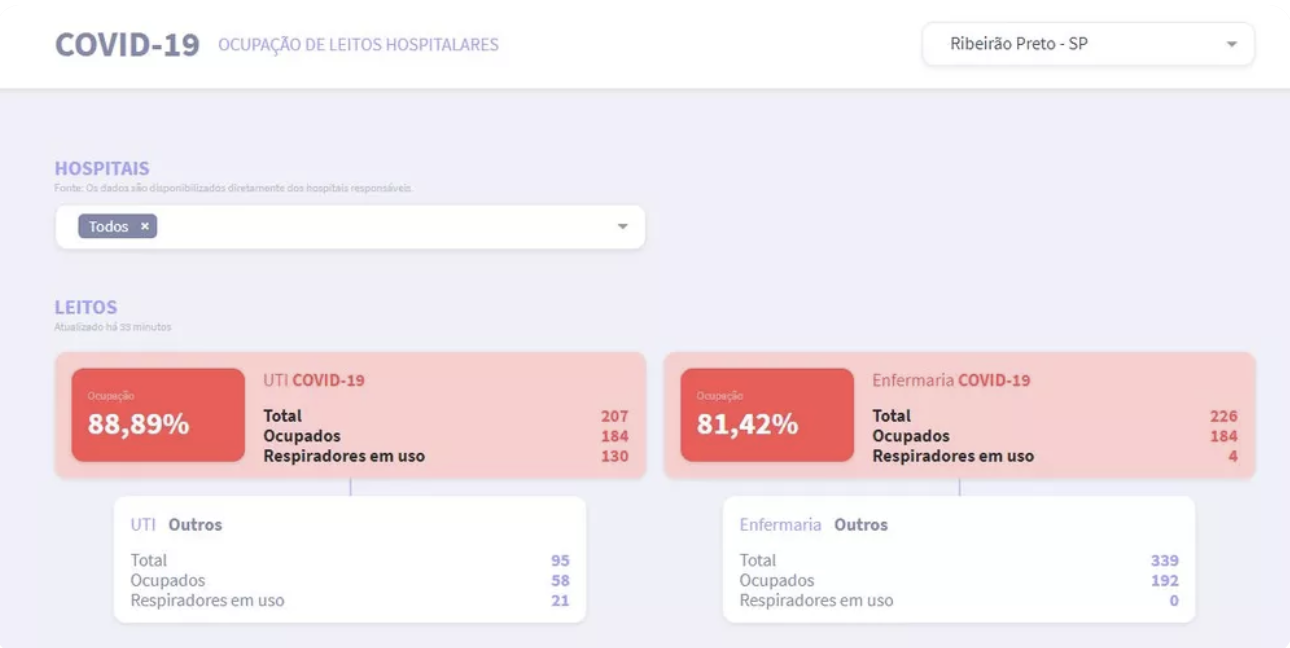
The result was LeitosCOVID.org, a digital platform designed to centralize and standardize real-time data on hospital bed occupancy — including regular and ICU beds — across all hospitals in Ribeirão Preto, a city of over 700,000 inhabitants and headquarters of Grupo BILD.
Problem
During the pandemic, hospital bed occupancy data was:
- Fragmented across multiple hospitals and systems
- Difficult to consolidate in real time
- Not easily accessible to public decision-makers
- Lacking a unified, reliable source for regional monitoring
This created a critical gap for the municipality:
- The city's classification under the Plano São Paulo depended directly on accurate occupancy data
- Inaccurate or delayed information could lead to misguided public health decisions or unnecessary economic restrictions
- The local government needed a single, trusted platform to monitor capacity and inform policy actions
Approach & Role
As Product Manager, I was responsible for leading the product definition and coordination across technical, institutional, and public stakeholders.
My role included:
- Defining the product vision and scope for a city-wide hospital bed monitoring platform
- Coordinating the integration of data from all public and private hospitals in the region
- Structuring a standardized data model for regular and ICU bed occupancy
- Working closely with engineering teams to ensure reliability, clarity, and usability
- Leading engagement with municipal stakeholders to align the platform with public health and policy needs
The project required fast execution, high data accuracy, and continuous alignment with public-sector requirements under crisis conditions.
Output & Results
- Delivery of LeitosCOVID.org, a centralized, real-time hospital bed occupancy platform
- Official adoption of the platform by the Municipality of Ribeirão Preto as the city's primary monitoring tool
- Direct support to public decision-making related to health measures and economic restrictions
- Contribution to transparency and coordination during a critical public health emergency
- Post-launch interest from other municipalities seeking to adopt the platform
- Demonstrated impact of a pro bono, innovation-led initiative with tangible social outcomes
Context & Challenge
After joining Grupo BILD in 2019, I consistently expressed interest in taking on leadership responsibilities within the organization. Alongside my day-to-day product work, I invested in my professional development by completing a specialization in digital product management, launching the group's digital product ecosystem across additional regions, and engaging in a structured mentorship process with my direct manager.
As a result, I was selected to participate in the group's internal leadership and management development program. Following this trajectory, I was invited to temporarily assume a Product Operations–focused role, supporting the growing Innovation area and its multiple product squads.
At that stage, the Innovation team faced a common scaling challenge:
product teams were operating with inconsistent documentation, workflows, and performance visibility, making it difficult to align execution, onboard new members, and assess team capacity.
Problem
As the number of squads and Product Managers increased, the lack of standardized processes created friction across the organization:
- Inconsistent documentation formats across squads
- Variability in how product requirements were translated into delivery tasks
- Limited visibility into squad capacity and performance
- High dependency on individual working styles rather than shared standards
Without intervention, this fragmentation risked slowing delivery, reducing clarity for designers and engineers, and limiting leadership's ability to make informed decisions.
Approach & Role
In a Product Operations capacity, I worked closely with other Product Managers to standardize product management practices across all innovation squads.
My responsibilities included:
- Designing and implementing standard documentation templates using Notion, including:
- One-on-one meeting structures
- Project kickoff and discovery documentation
- Product scope and initiative tracking
- Establishing a consistent task and delivery structure in ClickUp, standardizing:
- Card creation and hierarchy
- Information handoff from Product to Design and Engineering
- Naming conventions and workflow stages
- Defining performance and capacity indicators to measure squad throughput and utilization
- Acting as a reference point for tooling best practices across the Product team
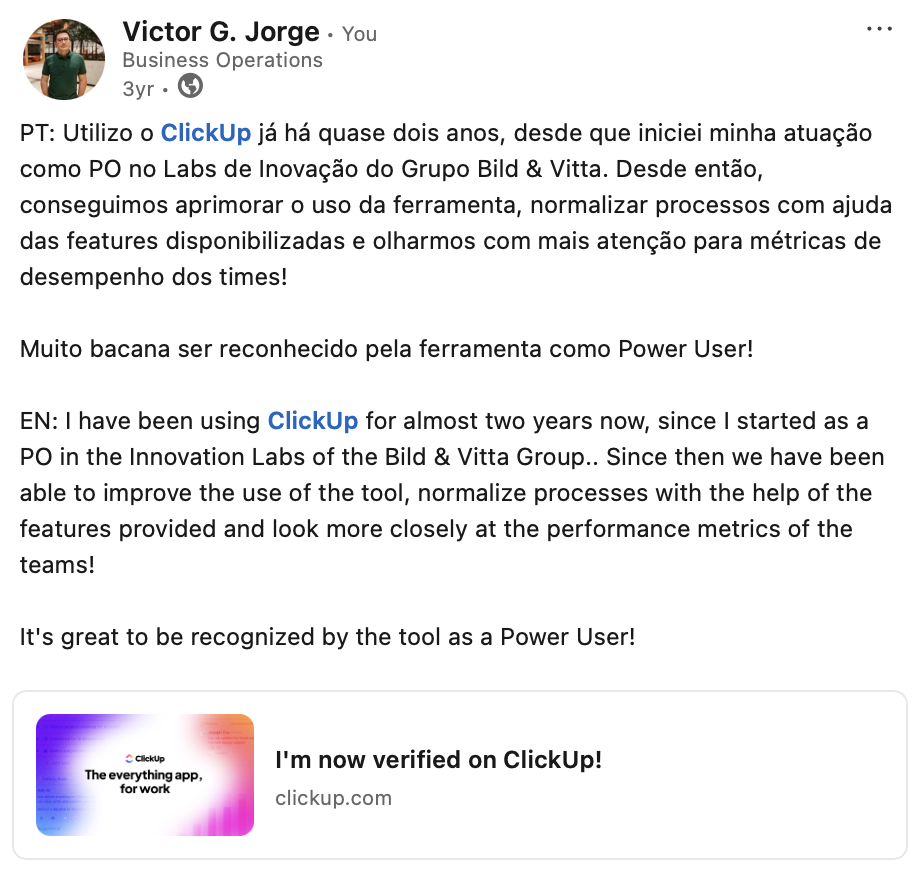
Through this work, I became recognized internally as a ClickUp power user, which led to direct interaction with the ClickUp team.
Output & Results
- Standardized product documentation adopted across all innovation squads
- Improved clarity and consistency in how product requirements were translated into delivery work
- Increased visibility into squad capacity and performance, supporting better planning and prioritization
- Reduced dependency on individual PM styles in favor of shared operational standards
- Ongoing monthly interactions with the ClickUp team (U.S.-based), providing structured feedback and product improvement suggestions
- Reinforced positioning as a trusted operator and emerging leader within Grupo BILD's innovation organization